
How Many Applications Does It Take to Get a Job in 2026? 40+ Stats + 225 Real Job Seeker Reports
Most people who land a job send somewhere between 30 and 300 applications. The famous per-job numbers count every applicant, not what one person needs.
Key job application statistics for 2026
Every row says exactly what it measures and who was counted. Sources are linked, and the full list with caveats is further down.
| What it measures | Figure | Source |
|---|---|---|
| Median applications sent before a job offer, Reddit job seekers who got one (n=117) | 100 | Our Reddit tally, 2023-2026 |
| Share of all applicants who get a job offer, Gem customers | 0.5% (about 1 in 200) | Gem, 2026 |
| Average applications per job on Greenhouse, 2025 | 244 (116 in 2022) | Greenhouse, 2026 |
| Share of applications that get an interview, Ashby customers, Q1 2026 | 3.6% to 4.7% (about 7-8% in 2021) | Ashby, 2026 |
| Share of interviewing candidates who get an offer, Ashby, Q1 2026 | 10.4% business roles, 7.3% technical roles | Ashby, 2026 |
| Huntr users who needed 50 or fewer applications to land a first offer | 61.2% | Huntr, Q2 2026 |
| Huntr users who needed more than 100 applications to land a first offer | 16.7% | Huntr, Q2 2026 |
| Applications per interview, US unemployed jobseekers (2018 data) | About 6 | BLS, 2020 |
| Americans surveyed who got at least one job offer in the past 4 months, July 2026 | 15.4% (19.4% in July 2024) | NY Fed, 2026 |
| Median length of a US unemployment spell, September 2026 | 11.5 weeks (9.1 in Sept 2023) | BLS via FRED |
| Median days from starting a search to a first offer, Huntr users, Q2 2026 | 82 days | Huntr, Q2 2026 |
| Median applications sent so far by Reddit job seekers still searching (n=67) | 300 | Our Reddit tally, 2023-2026 |
Two numbers get mixed up. "Applications per job" (about 244 on Greenhouse) counts everyone who applied to one opening. "Applications per person" is how many one job seeker sends before an offer. Almost every viral stat is the first kind, quoted as if it were the second.
How many applications does it take to get a job?
For one person, the best data says most offers come after fewer than 100 applications, with a long tail of people sending hundreds. Only three sources measure it per person: a 2018 government survey, Huntr's logged applications and our own Reddit tally.
- About 1 interview per 6 applications. US unemployed jobseekers sent an average of 13.67 applications and got 1.93 interviews over two months (BLS Beyond the Numbers, 2020, using 2018 survey data).
- 26.2% of those jobseekers had received a job offer. It was 36.9% for people with at least one interview and 9.9% for people with none (BLS, 2020).
- 61.2% of Huntr users who landed a first offer needed 50 or fewer applications. 26.0% needed 11 to 20, 16.2% needed 21 to 30, 19.1% needed 31 to 50, 22.1% needed 51 to 100 and 16.7% needed more than 100 (1,554 users, July 2025 to June 2026, Huntr Q2 2026 report).
- Nearly 1 in 5 Huntr users sent over 100 applications to get an offer in 2025 (Huntr 2025 annual report).
- Median of 100 applications before an offer among 117 Reddit job seekers who said they got one. The middle half sent 30 to 325 (our tally, see the Reddit section below).
- Only 15.4% of Americans surveyed got a job offer in the past 4 months in July 2026, down from 19.4% in July 2024 and 20.4% in November 2023 (NY Fed Survey of Consumer Expectations, 2026; we added up the offer columns in its chart data, and our July 2024 total matches the published 19.4%).
- 18.0% expect to get at least one offer in the next 4 months, the lowest since March 2021 (NY Fed, July 2026).
How many people apply for one job?
Employer data shows the pile on the other side of the desk. It has more than doubled since 2022.
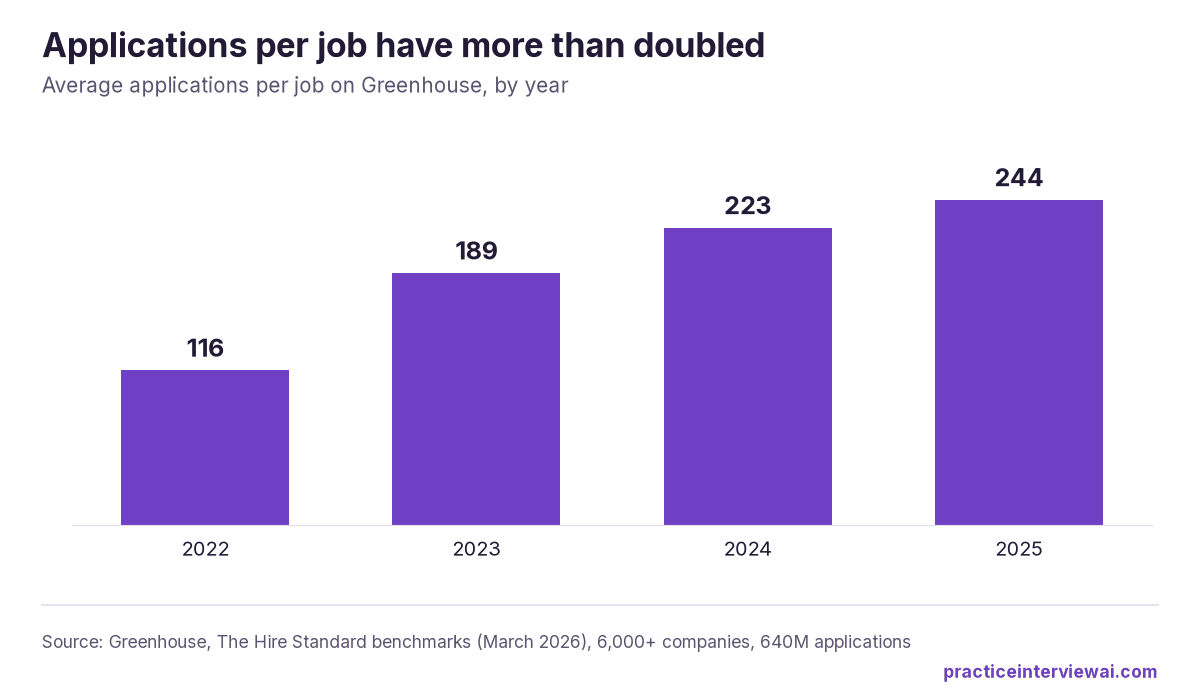
- 244 applications per job on Greenhouse in 2025, up from 116 in 2022, 189 in 2023 and 223 in 2024 (6,000+ companies, 640M applications, Greenhouse benchmarks, March 2026).
- Applications per recruiter went from 1,610 to 4,890 over the same period, and time to fill went from 43.6 to 59.7 days (Greenhouse, 2026).
- More than 300 applications per hire throughout 2025 on Ashby, and 291 now, against about 100 in early 2021 (109M applications, Ashby Talent Trends, April 2026).
- Median of 69 applicants per filled job for Workday customers, up from 58 a year earlier. Applicants per filled job rose 40% in tech and media and 27% in financial services (Workday Global Workforce Report, 2026).
- 180 applicants per hire at small businesses, from 234 in automotive down to 57 in education and childcare (10M+ applications, 2024 data, CareerPlug 2025 Recruiting Metrics Report).
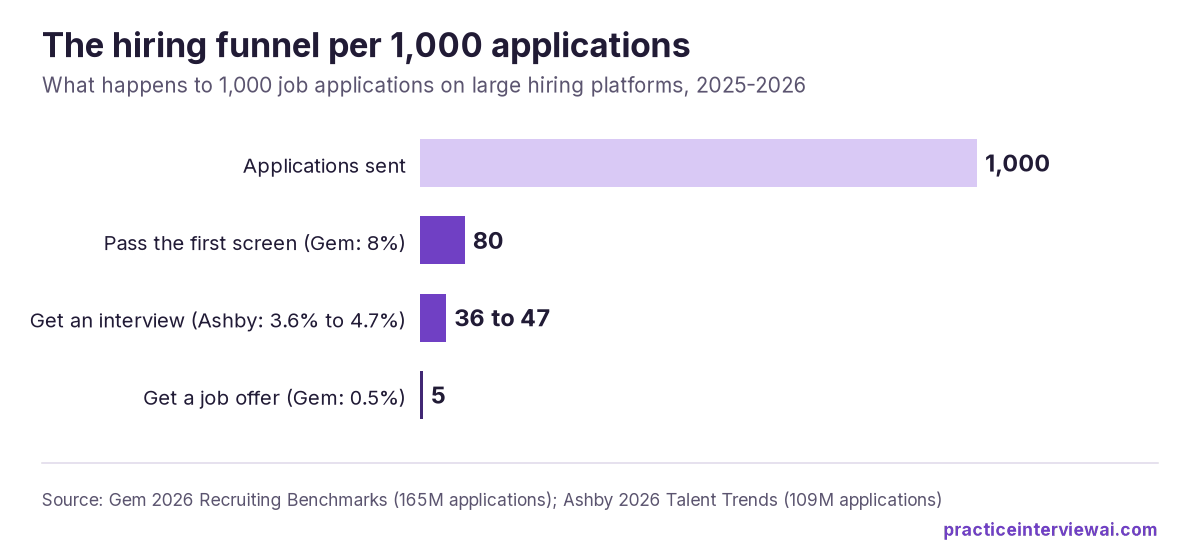
- 8% of applicants pass the first screen and 0.5% get an offer, roughly one hire per 200 applications (165M applications, 1.2M hires, Gem 2026 Recruiting Benchmarks).
- Referrals are 11 times more likely to be hired than inbound applicants, and job boards plus marketing bring about 90% of applications but only about half of hires (Gem, 2026).
- Hires per US job posting fell from 0.75 in 2018 to below 0.5 in 2023 (Revelio Labs, updated 2026).
- Remote jobs were 19.4% of paid LinkedIn posts but drew 50.1% of applications in February 2022 (LinkedIn Talent Blog, 2022).
What percentage of job applications get an interview?
Somewhere between 3% and 8%, depending on where and how you apply. Where you apply moves the rate more than almost anything else in the data.
- About 7-8% of applications got an interview in 2021, against 3.6% to 4.7% now, depending on role type (Ashby, Q1 2026).
- 3% of small-business applicants get an interview (CareerPlug, 2025; the report also says 2% in one sentence).
- Applying on employer career sites got interviews 6.42% of the time, against 5.29% on ATS domains such as Workday and 3.82% on job boards (80,719 applications, Huntr Q2 2026).
- Applications found through Google got interviews 7.91% of the time, LinkedIn 3.36% (601,815 applications, July 2025 to June 2026, Huntr).
- By job site in 2025: Google Jobs 11.3%, GovernmentJobs 8.7%, Wellfound 6.0%, Indeed 4.5%, LinkedIn 3.1%, ZipRecruiter 2.8% (Huntr 2025 annual report).
- Remote-only jobs: 3.53% interview rate, against 5.86% for onsite and 6.07% for hybrid (45,915 applications, Huntr Q2 2026).
- A tailored resume got 1.85 times the interview rate of an untailored one in Q2 2026 (Huntr).
- Applying 8 or more times to one company: 1.85% interview rate per application, against 6.14% for people who applied once (Huntr Q2 2026).
- Jobs that listed a salary: 4.38% interview rate, against 6.21% for jobs that did not (102,777 applications, Huntr).
- Interview rate by experience: 7.41% at 0-1 years, 4.29% at 2-4, 6.29% at 5-9, 5.98% at 10-19 and 7.24% at 20+ years (Huntr Q2 2026).
How many interviews does it take to get a job offer?
Once you are interviewing, the odds improve a lot: roughly 1 in 10 interviewing candidates gets an offer on Ashby, against about 1 in 200 applicants overall.
- 10.4% of interviewing candidates in business roles get an offer, 7.3% in technical roles, up from lows of 5% and 3.9% in early 2023 (Ashby, Q1 2026).
- 11.7 interviews per hire for business roles and 17.6 for technical roles, up 36% and 52% since 2021. By function: Data 19.5, Product 18, Engineering 17.9, HR 14.3, Customer Support 9.5 (Ashby, 2026).
- 27% of small-business interviews end in a hire (CareerPlug, 2025).
- 20 interviews per hire, up from 14 in 2021, and applicants were 3 times less likely to be hired than three years earlier (Gem 2025 Recruiting Benchmarks).
- The person who gets hired spends 2.4 hours interviewing for a business role and 3.5 hours for a technical role, flat since 2021 (Ashby, 2026).
- Reddit job seekers who got an offer went to a median of 6 interviews per offer (n=64; some count each round as an interview, some count each company).
Offer rates are where interview prep matters most. Our STAR method guide and the most common behavioral interview questions cover what gets asked in most first rounds.
Does sending more applications help you get a job?
Up to a point. Both the government survey and Huntr's data show diminishing returns once people send a very large number.
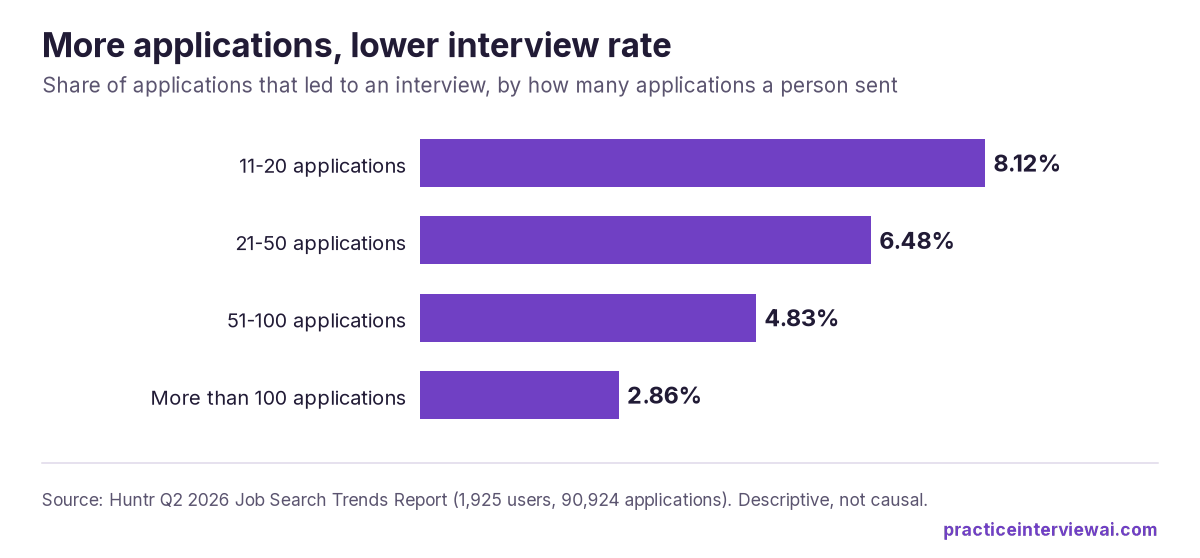
- Interview rate falls as volume rises: 8.12% for people sending 11-20 applications, 6.48% for 21-50, 4.83% for 51-100 and 2.86% for 100+ (1,925 users, Huntr Q2 2026; Huntr notes this is descriptive, not causal).
- Chance of an offer by applications sent: 13.2% with none, 27.2% with 1-10, 29.5% with 11-20, 30.9% with 21-80 and 20.4% with more than 80 (BLS, 2018 data).
- Offer odds drop the longer someone is unemployed: 30.9% for people out of work under 5 weeks, 18.4% at 27 weeks or more (BLS, 2018 data).
How long does it take to find a job in 2026?
About three months for a typical search, and longer than it was two years ago.
- Median unemployment spell: 11.5 weeks in September 2026, up from 9.1 weeks in September 2023 and 9.2 in September 2019. The mean is 24.8 weeks (BLS via FRED).
- 27.3% of unemployed Americans have been out of work for 27 weeks or more (1.94 million people, September 2026), against 19.8% in September 2023 (BLS via FRED, our calculation).
- About 1.01 job openings per unemployed person in August 2026, against 2.04 at the March 2022 peak (JOLTS via FRED, our calculation).
- Median 82 days from starting a search to a first offer for Huntr users in Q2 2026, down from a record 108 days in Q1 (Huntr Q1 2026, Q2 2026).
- Median 6 days from application to interview and 10 days from interview to offer (Q2 2026, Huntr).
- Median 30 days from application to accepted offer for business roles, 40 for technical roles (Ashby, 2026).
- About 1 in 4 job seekers surveyed had been searching a year or longer, and about 10% over two years (about 1,000 respondents, self-selected, Huntr 2025).
Once you reach the final round, the wait changes. See how long it takes to hear back after a final interview.
Is AI making it harder to get a job?
AI has made applying cheaper, so the number of applications has jumped and each one is less likely to get a reply.
- Applications on LinkedIn rose more than 45% in a year, to about 11,000 a minute, as reported by the New York Times in June 2025 (LinkedIn has not published the underlying data).
- Job applications grew 2.6 to 3 times at the start of 2024 for Ashby customers (Ashby, 2026).
- 49% of job seekers are sending more applications than a year earlier, and 34% of recruiters spend up to half their week filtering spam and junk applications (Greenhouse, November 2025).
- 22% of candidates use bots to apply automatically, 31% of Gen Z (Greenhouse 2025 Workforce and Hiring Report).
- 63% of job seekers have faced an AI interview. Afterward, 51% never heard back, 28% advanced and 13% were rejected (2,950 job seekers, Greenhouse, 2026).
- 93% of job seekers surveyed have applied to, or suspect they applied to, a ghost job, and 18% had an offer withdrawn in Q1 2026 (593 respondents, self-selected, Huntr Q1 2026).
What Reddit job seekers report: 225 real searches
No public dataset shows how many applications one person sends by field, so we built one. We read 31 Reddit threads where people shared their own numbers and coded every comment that stated them. That gave 225 job searches; 200 of them give an application count.
Treat this as what Reddit job seekers report, not a market rate. The numbers are self-reported, the people chose to post, and the sample leans toward tech and toward people who found the search hard.
| What we measured | People (n) | Median | Middle half |
|---|---|---|---|
| Applications before an offer, everyone who got one | 117 | 100 | 30 to 325 |
| Applications before an offer, searches in 2024-2026 only | 93 | 100 | 36 to 330 |
| Applications before an offer, software and tech, 2024-2026 | 33 | 150 | 50 to 500 |
| Applications before an offer, non-tech or field not stated, 2024-2026 | 60 | 86 | 32 to 300 |
| Applications before an offer, UK graduates | 16 | 48 | 29 to 225 |
| Applications sent so far by people still searching | 67 | 300 | 110 to 619 |
| Applications per interview, people who got an offer | 58 | 12.5 | 6 to 30 |
| Applications per interview, people still searching | 44 | 67 | 16 to 154 |
| Interviews per offer, people who got an offer | 64 | 6 | 2.5 to 12 |
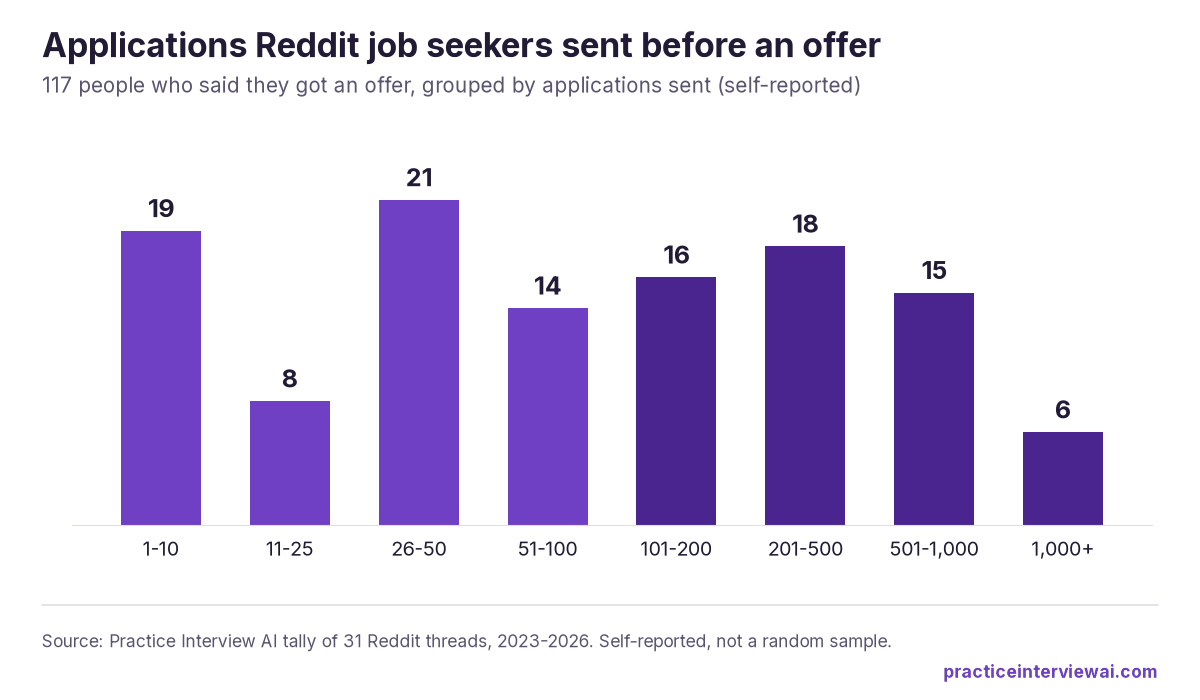
The spread is wide: 47% of the people who got an offer sent more than 100 applications and 18% sent more than 500, while 41% got there with 50 or fewer. A few outliers (10,322 applications, and 7,500 and 2,200 from auto-apply tools) barely move the medians.
Which job application stats are wrong?
Several of the most quoted numbers have no study behind them.
Myths we checked
- "Each corporate job gets 250 resumes, 4 to 6 people get an interview and 1 gets the offer."No sourceIt traces back to a Glassdoor blog list of HR stats from around 2015, which cites only Glassdoor's own ebook. There is no study, sample or year behind it, and later stat pages cite each other in a circle. Measured numbers today land in a similar range by coincidence: 244 applications per job (Greenhouse, 2025) and about 200 applications per hire (Gem, 2026). Quote those instead.
- "Only 2% of applicants get an interview."Not measuredIt looks like arithmetic from the 250 claim (5 of 250). Measured rates are 3% at small businesses (CareerPlug, 2025) and 3.6% to 4.7% on Ashby (2026), and 8% of applicants pass Gem's first screen.
- "Each job gets 118 applicants and 20% get an interview."No sourceIt circulates from an old recruiting infographic. We could not find a dataset behind it.
- "It takes 6 applications to get an interview."OutdatedReal, but it is BLS data from 2018, for unemployed people only, published in 2020. Interview rates on hiring platforms have roughly halved since 2021.
- "It takes about 6 months to find a job."MisleadingThe median US unemployment spell is 11.5 weeks (September 2026). The 24.8-week mean is pulled up by long searches, so 6 months describes a long search, not a typical one.
- "It takes 32 to 200+ applications to get a job."No sourceThese ranges appear on ranking pages with no method. The closest real data is Huntr's logged applications and our Reddit tally above.
How we checked these numbers
We opened every source linked on this page in October 2026 and checked each figure against it. Where a source reports a survey, we name the sample. A few things to keep in mind:
- Greenhouse, Ashby, Gem, Workday and CareerPlug are hiring software companies reporting on their own customers. Their numbers describe applications on their platforms, not the whole job market.
- Huntr's figures come from job seekers who log applications in its tracker. The sample leans toward tech, and its rates are descriptive, not causal.
- The BLS funnel figures use 2018 data published in 2020. They are the only government measure of applications per interview, so we label the year every time.
- We calculated three figures ourselves from official data: the NY Fed job offer share (we summed the offer columns in its chart data), the long-term unemployment share and openings per unemployed person (from BLS series on FRED).
- The LinkedIn growth figure is as reported by the New York Times; LinkedIn has not published the data.
- Reddit tally: 31 threads from 2023 to 2026, mostly 2025 and 2026, across subreddits such as r/jobs, r/cscareerquestions, r/recruitinghell, r/csMajors, r/UKJobs and r/jobsearch. One row per job search. Ranges were coded at the midpoint (40-50 counts as 45) and "thousands" as 2,000.
Last verified October 2026.
Frequently asked questions
How many applications does it take to get a job in 2026?
There is no single number. Among Huntr users who landed a first offer, 61% needed 50 or fewer applications and 17% needed more than 100 (Huntr, 2026). Reddit job seekers who got an offer report a median of 100. Employer data says about 1 in 200 applications ends in a hire (Gem, 2026), but that counts every applicant, not one person.
How many applications per interview is normal?
Platform data puts it at roughly 1 interview per 20 to 30 applications in 2026 (3.6% to 4.7% on Ashby). BLS found about 1 per 6 in 2018 among unemployed jobseekers. Reddit job seekers who got an offer report a median of 12.5 applications per interview.
Is 100 applications a lot?
It is common. 47% of Reddit job seekers in our tally who got an offer sent more than 100, and Huntr found nearly 1 in 5 of its users needed over 100. But Huntr also found interview rates fall as volume rises, so more targeted applications tend to beat mass applying.
How many interviews does it take to get a job offer?
On Ashby, 10.4% of interviewing candidates for business roles and 7.3% for technical roles get an offer (Q1 2026). Reddit job seekers report a median of 6 interviews per offer. BLS found 37% of jobseekers with at least one interview got an offer (2018 data).
How long does it take to find a job in 2026?
The median US unemployment spell was 11.5 weeks in September 2026 (BLS). Huntr users took a median of 82 days from starting a search to a first offer in Q2 2026, after a record 108 days in Q1.
Getting interviews is half of it. When yours start landing, our free first mock interview lets you practice answers out loud and see where they fall short.